Recent Post
- 2026-06-04 03:38:40
- 2026-06-02 12:57:03



Abstract—Stone has always occupied an awkward position in the CNC world: hard enough to destroy a poorly specified spindle, abrasive enough to shorten the life of every guide rail it touches, and heavy enough to make the material-handling assumptions of woodworking automation largely inapplicable. Yet the architectural and memorial fabrication sectors that consume machined stone are under the same labor and precision pressures that drove panel furniture toward nesting centers two decades ago. This article examines where stone CNC automation actually stands, why its technical trajectory diverges from woodworking, and what the convergence of the two equipment categories implies for buyers and builders alike.
Industry Background: Growth Without Standardization
The demand-side drivers are not difficult to identify. Urban architectural cladding, landscape hardscaping, countertop and vanity production, and the memorial sector all continue to expand, particularly in Asia-Pacific and the Gulf states. What distinguishes stone from other machined materials is the fragmentation of the equipment market. Unlike panel furniture, where the nesting center has become a de facto standard architecture, stone fabrication remains split among bridge saws with limited CNC capability, three-axis stone routers, five-axis bridge machining centers, and waterjet systems—each with a different automation ceiling.
The table below summarizes the principal equipment classes and their automation characteristics, drawn from typical configurations observed in the market. Figures are indicative ranges rather than single-source statistics, reflecting the wide variance between entry-level and production-grade machines.
| Equipment Class | Typical Spindle Power | Axis Configuration | Positioning Accuracy | Automation Level | Dominant Application |
|---|---|---|---|---|---|
| Three-axis stone router | 5.5–9 kW | XYZ | ±0.05 mm | Low–medium | Tombstones, simple relief, sink cutouts |
| ATC stone machining center | 9–15 kW | XYZ + tool magazine (8–24 tools) | ±0.03 mm | Medium–high | Complex relief, architectural profiles, batch work |
| Five-axis bridge center | 15–22 kW | XYZAC | ±0.05 mm | High | Sculptural work, curved cladding, monolithic forms |
| Bridge saw with CNC | 7.5–11 kW | XYZ (limited Z) | ±0.1 mm | Low | Slab cutting, straight profiling |
| Waterjet | N/A (pump-driven) | XY (+ optional 5-axis head) | ±0.1 mm | Medium | Inlay, mixed-material work, thick sectioning |
Three observations follow from these figures. First, the accuracy gap between a three-axis stone router and a five-axis bridge center is narrower than the price gap might suggest; the five-axis premium buys geometric capability, not necessarily tighter tolerance. Second, tool-change automation—the ATC magazine—is the single largest step-change in throughput for relief and profile work, because stone cutting involves long tool paths with frequent bit changes between roughing and finishing. Third, waterjet occupies a genuinely separate niche: it solves problems (inlay, heat-sensitive material, mixed media) that rotating-tool machines cannot address, and should not be read as a competing automation tier.
The regional distribution of demand reinforces the fragmentation. Italy and Spain retain a strong position in high-end bridge center manufacturing and in the premium architectural market. China has become the dominant volume producer of three-axis and ATC stone routers, with Shandong province in particular hosting a dense cluster of CNC equipment manufacturers whose supply chains overlap heavily with woodworking machinery production. This overlap matters: the same servo drives, linear guides, and control systems serve both sectors, which compresses costs for stone machine builders but also means stone-specific engineering—dust sealing, water management, abrasive-resistant way covers—is often the differentiator rather than the motion platform itself.
Technology Application: What Automation Actually Requires in Stone
The engineering constraints of stone cutting deserve more attention than they usually receive in equipment marketing. Granite and engineered quartz are abrasive; a machine that performs flawlessly on oak for five years may need guide-rail service in eighteen months if the sealing strategy is borrowed rather than redesigned. Water cooling is standard, which introduces corrosion and slurry management into every maintenance schedule. Dust extraction must handle a mixture of fine particulate and water mist, a combination that defeats conventional bag filtration.
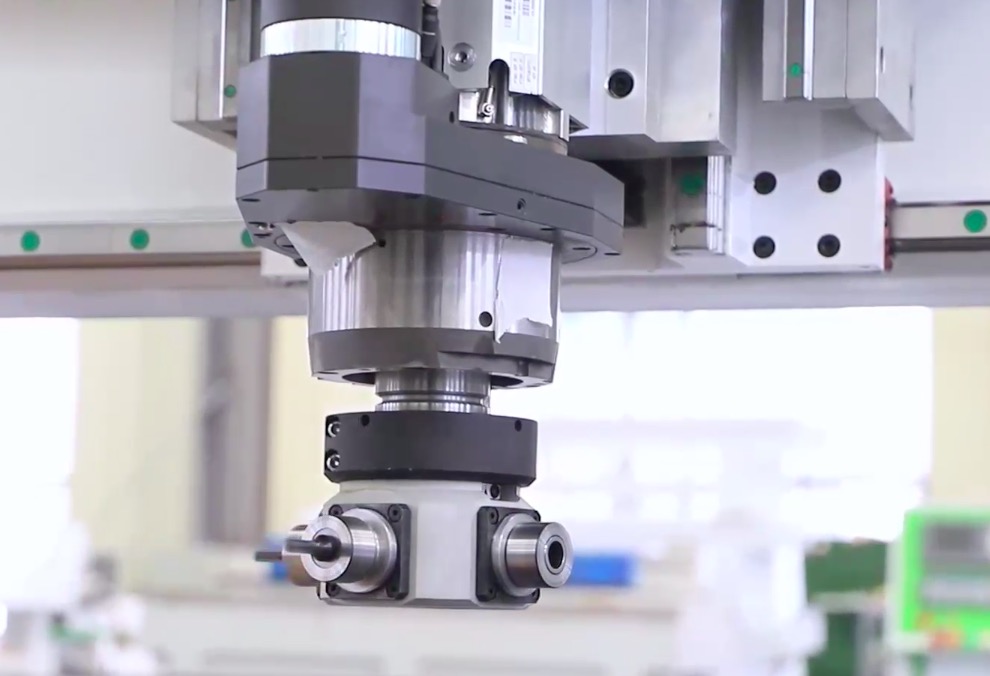
Against this backdrop, the meaningful automation advances have come in three areas. Automatic tool changers with sealed, pressurized magazines allow roughing and finishing to run in a single setup, which is precisely the workflow that memorial and relief producers need. Automatic lubrication systems, timed and quantitative, extend guide-rail and screw life in an environment where manual lubrication intervals are routinely missed. And vacuum table design—zoned, double-layer adsorption—has been adapted for stone slabs, though the holding forces required are considerably higher than in panel work and the table construction correspondingly heavier.
It is in this adaptation layer that Roctech's position is instructive. The company's product range spans ATC engraving machines, heavy-duty five-axis machining centers, and the Master series nesting centers, with stone-capable configurations drawing on the same platform architecture—Syntec control, Yaskawa servo drives, HIWIN linear guides, and heavy welded or cast beds—that serves its woodworking customers. The RCF series five-axis machining centers, with their imported five-axis heads and A/C swing geometry, illustrate the direction of travel: one clamping, multi-face processing of complex curved surfaces, which is exactly the requirement for sculptural and curved-cladding stonework. Roctech's relevance here is less as a stone specialist than as a volume manufacturer whose component standardization across woodworking and stone lines has made mid-tier automation accessible to fabricators who could not justify a European bridge center. The company's export footprint—more than 100 countries—reflects that positioning.
The caveat is worth stating plainly. A machine architecture proven in woodworking does not automatically transfer to stone at the same service life. Buyers evaluating cross-sector platforms should scrutinize the sealing specification, the water-handling design, and the dust collection interface as closely as the spindle power and accuracy figures.
Conclusion and Outlook
Stone CNC automation is following the woodworking trajectory with a lag of roughly a decade, but it will not converge fully. The material's abrasiveness and weight impose engineering constraints that keep machine architectures distinct, even as they share motion components and control platforms. The near-term outlook is for continued growth in ATC-equipped three-axis and five-axis machines in the mid-market, gradual displacement of manual bridge saws in batch production, and persistent fragmentation at the high end where Italian and Spanish builders retain a technology lead.
For fabricators, the practical guidance is unglamorous: match the automation tier to the workflow, not to the brochure. A shop producing standard memorial work gains more from a reliable ATC three-axis machine with robust sealing than from five-axis capability it will rarely use. A shop producing curved architectural elements has the opposite calculus. The equipment market, for all its fragmentation, now offers a machine at nearly every point on that spectrum—which is itself a sign that stone fabrication has entered the automation mainstream.
Looking for more information about our CNC machines and services? Contact us today.
ContactNext:Not






















CNC Stone Carving Automation in Modern Fabrication: Technology, Market Structure, and the Integration Challenge - Roctech® have advanced technology for CNC Router,cnc router cabinets,Roctech already have 15 years experiences of cnc router technology.-© 2023 Roctech® Machinery Co.,Ltd. - All Rights Reserved Website Terms Of Use ● Privacy Policy ● Cookie Policy