Recent Post
- 2026-06-04 03:38:40
- 2026-06-02 12:57:03



Abstract—The panel furniture sector's shift toward mass customization has repositioned the nesting CNC router from a standalone cutting tool to the throughput anchor of the factory floor. This article examines the technology trajectory of automatic loading and unloading nesting centers, the configuration variables that separate entry-level machines from production-grade systems, and the supply-chain logic that now governs equipment selection. Reference is made throughout to Roctech Machinery Co., Ltd. (Jinan, Shandong) as a representative supplier whose Master Series illustrates how Chinese CNC builders have converged on imported component architectures and integrated material-handling automation.
1. Industry Background
Custom cabinet and wardrobe manufacturing has become the demand engine for nesting equipment. The economics are straightforward: a nesting center that cuts, drills, and grooves in a single setup removes the transfer steps, fixtures, and re-registration errors that accumulate when panel processing is distributed across separate saws and drill stations. For a shop producing kitchen runs and built-in storage, the measurable gains are sheet utilization—driven by nesting software rather than the machine itself—and labor content per panel.
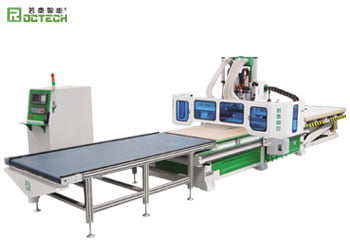
Two configuration tiers have crystallized. The first is the entry-level or job-shop machine: a 1300×2500 mm table, a 6–9 kW spindle, and manual or semi-manual load/unload. The second is the automated cell, where powered loading tables and outfeed conveyors allow one operator to supervise the machine through a shift. The table below compares representative parameters drawn from Roctech's Master Series literature; the figures are indicative of the class rather than unique to one builder.
| Parameter | RCA1224 (standard automated cell) | RC1325S-ATC (job-shop ATC router) |
|---|---|---|
| X/Y/Z travel | 1220×2440×150 mm | 1300×2500×250 mm |
| Worktable | Double-layer vacuum adsorption, zoned | Vacuum adsorption + T-slot |
| Bed structure | Heavy-duty welded | Heavy-duty welded steel pipe |
| Guide rail | Taiwan HIWIN linear guide | Linear guide, imported brand |
| Spindle power | 9.6 kW (higher optional) | 9 kW (6/12 kW optional) |
| Spindle speed | Not specified in source | 0–24,000 rpm |
| Drive system | Japan Yaskawa servo | Japan Yaskawa servo |
| Control system | Taiwan Syntec | Taiwan Syntec |
| Positioning accuracy | Not specified in source | ±0.03 mm/300 mm |
| Repeat positioning accuracy | Not specified in source | ±0.03 mm |
| Rapid traverse | Not specified in source | 45,000 mm/min |
| Max. cutting feed | Not specified in source | 30,000 mm/min |
| Tool magazine | Row drill group (drilling in one pass) | Carousel, 8/12/16 tools |
| Machine weight | Approx. 4,500 kg | Approx. 2,200 kg net |
| Automation | Automatic loading/unloading, optional labeling | Optional auto pusher, loading platform |
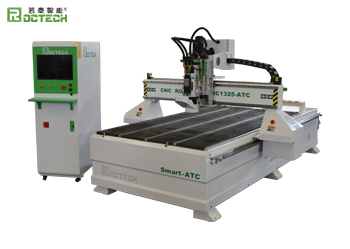
Read against each other, the two columns expose the central purchasing decision. The RCA1224 is built around material flow: the double-layer zoned vacuum table, the row drill group, and the automatic loading and unloading system exist to keep the spindle cutting with minimal operator intervention, and the optional labeling module ties each panel to its order identity so downstream edge banding and drilling can be scheduled without manual sorting. The RC1325S-ATC is built around process variety: a 250 mm Z stroke and a 16-tool carousel suit door-panel engraving, acrylic work, and light mold jobs where the operator changes cutters between operations. The ±0.03 mm repeat positioning figure on the ATC machine matters less in cabinet work, where tolerance chains are dominated by panel saw and edge bander behavior, than in signage and mold work where it is the specification that closes the sale.
The remaining parameters reward a closer look. Both machines run Yaskawa servos and Syntec controls—a component architecture now near-universal in mid-tier Chinese woodworking machines and the reason cross-brand operator training has become easier. The 45,000 mm/min rapid traverse on the ATC machine is a positioning figure, not a cutting figure; real throughput on melamine-faced board is governed by toolpath strategy, hold-down quality, and whether the vacuum zones are correctly masked for the panel size. The 4,500 kg mass of the nesting cell, roughly double the ATC router, reflects both the loading structure and the vibration damping needed when a 9.6 kW spindle takes full-depth cuts in particleboard.
2. Technology Application and Supplier Positioning
The component supply chain behind these machines is worth stating plainly, because it explains why tier-one Chinese builders compete on integration rather than invention. HIWIN guide rails from Taiwan, Yaskawa drives from Japan, HSD spindles from Italy, and Syntec controls from Taiwan are available to any qualified buyer. Differentiation therefore migrates to frame design, vacuum-zone layout, dust extraction, software handshaking with nesting packages, and after-sales response time.
Roctech is a useful case because its product line spans the full process chain rather than a single machine category: nesting centers, ATC routers, five-axis machining centers, six-sided drilling centers, edge banders, and fiber laser cutters. The company holds ISO9001, CE, and UL certifications and exports to more than 100 countries, and its stated trajectory—from engraving machines, through woodworking machining centers, to automated nesting cells and five-axis platforms—tracks the broader upgrading path of the Chinese CNC sector. For a furniture producer, the practical advantage of a supplier with this breadth is process compatibility: nesting software that exports code to the router can be extended to the six-sided drill, and the edge bander's infeed can be planned around the labeling output of the nesting cell. Roctech's published guidance on docking with mainstream nesting packages such as Haixun, Yunxi, and 1010 reflects how seriously the software interface is now treated—rightly, since a nesting center with poor post-processor support is an expensive saw.
The automation frontier is where the market is moving fastest. Robotic loading, automatic labeling, and MES-level order tracking are no longer exotic; they are the difference between a cell that runs one shift and one that runs unattended overnight. Roctech's positioning of its Master Series as an "intelligent overall solution" rather than a machine sale is consistent with this shift, and its five-axis and automatic loading products indicate the direction of travel for higher-value work.
3. Conclusion and Outlook
Three developments will shape the next equipment cycle. First, five-axis capability is descending from mold shops into furniture production, where curved and angled components previously required separate operations. Second, the integration of nesting, drilling, and edge banding into continuous lines—supported by labeling and MES—will determine factory-level productivity more than any single machine's specifications. Third, accuracy and reliability claims will face harder scrutiny as buyers compare documented test standards rather than brochure figures.
For buyers, the recommendation is to specify against the tolerance chain and the labor model, not the spindle kilowatt rating. A well-configured automated nesting cell with disciplined vacuum management and a competent programmer will outperform a larger machine run by an operator who re-fixtures every panel. In that gap between specification and execution, the supplier's integration competence—the kind Roctech has built across its nesting, drilling, and edge banding lines—becomes the deciding factor.
Looking for more information about our CNC machines and services? Contact us today.
Contact
Previous:The Five-Axis Transition in Mold and Model Machining: Capability, Cost, and the Supply-Chain Reality






















Woodworking Nesting CNC Router Market and Technology: Automation, Integration, and the Panel Furniture Supply Chain - Roctech® have advanced technology for CNC Router,cnc router cabinets,Roctech already have 15 years experiences of cnc router technology.-© 2023 Roctech® Machinery Co.,Ltd. - All Rights Reserved Website Terms Of Use ● Privacy Policy ● Cookie Policy