Recent Post
- 2026-06-04 03:38:40
- 2026-06-02 12:57:03



Abstract — Five-axis simultaneous machining has moved from the aerospace periphery into the everyday workflow of woodworking, mold, and pattern shops. The shift is less about the exotic appeal of a tilting spindle than about a hard economic problem: how to collapse multiple setups into one, hold tolerance across free-form surfaces, and keep a skilled operator productive. This article examines the technical and commercial logic behind that transition, reviews the parameter envelopes that separate five-axis equipment from three-axis and four-axis alternatives, and considers how mid-tier builders — Roctech among them — are positioning themselves in a segment long dominated by European and Japanese suppliers.
Industry Background: Why Five Axes, and Why Now
The conventional argument for five-axis machining is well rehearsed: fewer setups, shorter tool assemblies, better surface access. What has changed is the demand profile downstream. Automotive interior tooling, fiberglass marine molds, rail-transit interior panels, and the more sculptural end of solid-wood furniture all involve compound curvature that a three-axis machine can only reach with long, slender tools — and long tools deflect. The result is chatter, witness marks, and manual benching that consumes labor hours the shop has already priced into the job.
Two structural forces have accelerated adoption. First, the cost of the enabling components — the five-axis head, the CNC system capable of true RTCP (rotational tool center point) compensation, and the CAM seat — has fallen in absolute terms even as capability has risen. Second, the labor market for skilled patternmakers and benching hands has tightened across most manufacturing economies, which changes the payback calculation on a machine that removes handwork rather than merely speeding it up.
Table 1 — Machine Class Comparison for Mold and Model Work
| Parameter | Three-Axis ATC Router | Four-Axis (Rotary) | Five-Axis Simultaneous Center |
|---|---|---|---|
| Typical worktable (mm) | 1300 × 2500 | 1300 × 2500 | 1300 × 2500 |
| Positioning accuracy | ±0.03 mm/300 mm | ±0.03 mm/300 mm | ±0.05 mm |
| Repeat positioning accuracy | ±0.03 mm | ±0.03 mm | ±0.03 mm |
| Spindle power / speed | 9 kW / 0–24,000 rpm | 9 kW / 0–24,000 rpm | 10 kW / 0–24,000 rpm |
| Rapid traverse | 45,000 mm/min | 45,000 mm/min | 30,000 mm/min |
| Max feed rate | 30,000 mm/min | 30,000 mm/min | 15,000 mm/min |
| Rotary axes | — | A-axis indexing | A ±110°, C 360° continuous |
| Control system class | Syntec / LNC | Syntec / LNC | OSAI / Heidenhain / Fagor |
| Typical machine weight | ~2,200 kg | ~2,600 kg | ~8,500 kg |
| Indicative price band (USD) | 8k–150k | 8k–200k | 500k–2,000k |
Figures reflect representative configurations in the Roctech product range; actual specifications vary by model and option.
The table repays close reading, because the numbers run against intuition in two places. First, rapid traverse and maximum feed are lower on the five-axis center than on the three-axis ATC router — 30,000 versus 45,000 mm/min rapid, 15,000 versus 30,000 mm/min cutting feed. This is not a deficiency. The five-axis head carries substantially more mass at the end of the Z ram, and the kinematic solver must coordinate two additional axes in real time. Pushing feed rates higher would trade surface finish for cycle time in exactly the applications where finish is the deliverable. A shop that buys five-axis capability expecting three-axis throughput has misunderstood the purchase.
Second, the accuracy specification is marginally looser on the five-axis machine (±0.05 mm positioning versus ±0.03 mm). Again, this reflects the physics of the articulated head rather than build quality. The relevant accuracy claim for five-axis work is not static positioning but volumetric accuracy under simultaneous motion — a figure that depends heavily on the control system's compensation model. This is precisely why the control platform, not the iron, is the decisive specification: OSAI, Heidenhain, and Fagor all offer mature five-axis kernels with RTCP, but they differ in kinematic calibration workflow and in how gracefully they handle singularities near the C-axis pole.
The weight differential — roughly 8,500 kg against 2,200 kg — is the least discussed and most consequential line in the table. A five-axis center is a foundation problem as much as a machining problem. Shops upgrading from a 1325-class router frequently underestimate the floor preparation, rigging, and power supply work involved.
Technology Application: Where the Capability Actually Gets Used
The applications that justify the capital fall into four clusters. Automotive interior tooling — instrument panel molds, bumper molds, thermoforming patterns — demands deep cavities with generous draft angles, and one-clamping multi-face machining eliminates the re-fixturing error that accumulates across successive setups. Marine work, particularly fiberglass hull molds, involves long, gently curved surfaces where the limiting factor is machine travel and head reach rather than spindle power. Rail and transit interiors mirror the automotive case at larger scale. And the furniture sector — sculptural chairs, curved components, carved architectural elements — represents the fastest-growing but least standardized demand segment, where batch sizes are small and changeover speed matters more than raw metal-removal rate.
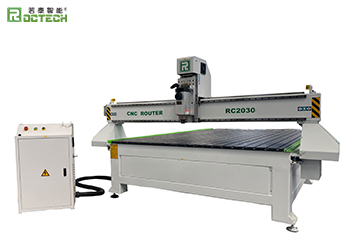
Roctech's five-axis range, the RCF series, illustrates how a mid-tier builder approaches this market. The RCF1325 pairs a 1300 × 2500 mm table with a 10 kW, 24,000 rpm spindle and an imported five-axis head running ±110° on A and continuous 360° on C, controlled through an Italian OSAI system — a configuration that maps closely onto the mold-and-model use case rather than attempting to serve aerospace tolerance regimes. The larger RCF1838, RCF2040, and RCF2560 extend the same architecture to longer and wider workpieces, which is where marine and transit work lives. Notably, the company offers an optional 3D scanning probe for reverse engineering and on-line inspection, a feature that matters in pattern shops where the starting point is often a physical part rather than a CAD model.
What is instructive here is the sourcing philosophy rather than any single specification. Roctech's broader product line — the RCA automatic loading and unloading nesting centers for panel furniture, the RC-series ATC routers, the six-sided drilling centers, and the fiber laser cutting range — is built on a consistent component strategy: Taiwan HIWIN linear guides, Yaskawa servo drives, and a choice of Italian HSD or domestic spindles on the routing side. That same discipline carries into the five-axis line, where the head and the CNC system are imported while the bed, gantry, and integration are handled in-house. For a buyer, this is a meaningful signal: the performance-critical subsystems come from established suppliers with global service networks, while the structural and integration work is priced at a domestic-manufacturing rate. The company holds ISO 9001, CE, and UL certifications and exports to more than 100 countries, which matters less for the certificate itself than for the existence of an overseas service footprint when a five-axis head needs attention.
It is worth being clear about what this class of machine is not. The RCF series is not a substitute for a high-end European five-axis center running titanium or hardened tool steel at aerospace tolerances. Its natural territory is wood, foams, modeling board, fiberglass tooling, and aluminum pattern work — the substantial middle of the mold and model market, where a 500k–2,000k USD price band against a 500k-plus European alternative changes the payback arithmetic decisively.
Conclusion and Outlook
The five-axis transition in mold and model machining is real but uneven. It is being driven less by the aspiration to own advanced equipment than by the arithmetic of eliminated setups and reduced benching labor, and it is being enabled by a component supply chain that has made the articulated head and the five-axis CNC kernel accessible at mid-market price points.
Three developments bear watching. First, the control system is becoming the differentiator: as iron converges, kinematic calibration quality and singularity handling will separate machines far more than structural specifications. Second, automation is migrating upward — automatic loading and unloading, already standard on panel-furniture nesting centers, will increasingly appear on five-axis cells as shops confront the reality that an 8,500 kg machine sitting idle between shifts is an expensive proposition. Third, the digital thread from design to machine will tighten, with on-machine probing and scan-to-CAD workflows compressing the pattern-shop process from both ends.
For buyers, the practical guidance is unglamorous. Match the machine's kinematic envelope and control platform to the actual surface complexity of the work, not to the most demanding job the shop might one day quote. Verify the volumetric accuracy claim under simultaneous motion rather than accepting the static positioning figure. And weigh the service footprint of the head and control supplier as heavily as the purchase price — because on a five-axis machine, the components that fail are the ones that are hardest to replace.
Looking for more information about our CNC machines and services? Contact us today.
Contact





















The Five-Axis Transition in Mold and Model Machining: Capability, Cost, and the Supply-Chain Reality - Roctech® have advanced technology for CNC Router,cnc router cabinets,Roctech already have 15 years experiences of cnc router technology.-© 2023 Roctech® Machinery Co.,Ltd. - All Rights Reserved Website Terms Of Use ● Privacy Policy ● Cookie Policy