
Recent Post
- 2026-07-02 08:31:31
- 2026-07-01 16:31:05
- 2026-07-02 04:30:48



Abstract
The question “What brand of tool grinder is good?” is deceptively simple. In precision CNC woodworking and stone engraving, tool sharpness directly determines cut quality, spindle load, and production throughput. This article examines the technical criteria for evaluating tool grinders, presents comparative market data, and discusses how proper tool maintenance integrates into automated production environments. Roctech’s positioning in the CNC equipment sector provides a relevant context for understanding tooling requirements in high-throughput operations.
Industry Background and Data Analysis
Tool grinding has evolved from a manual craft to a precision engineering discipline. Modern CNC tool grinders must maintain tolerances within ±0.01 mm to ensure consistent cutting performance across multiple tool changes. In woodworking nesting centers and stone engraving machines, a dull tool can reduce feed rates by 30–50% and increase spindle bearing wear due to vibration.
The following table summarizes key parameters of leading tool grinder brands commonly used in industrial CNC applications:
| Brand | Country | Typical Accuracy (mm) | Max Tool Diameter (mm) | Grinding Wheel RPM | Price Range (USD) | Best Application |
|-------|---------|----------------------|----------------------|-------------------|------------------|------------------|
| ANCA | Australia | ±0.005 | 320 | 10,000 | 80k–200k | High-volume carbide tool production |
| Walter | Germany | ±0.005 | 300 | 12,000 | 90k–250k | Precision tool resharpening, aerospace |
| Schneeberger | Switzerland | ±0.003 | 250 | 14,000 | 120k–300k | Micro-tools, complex geometries |
| Vollmer | Germany | ±0.01 | 200 | 8,000 | 60k–150k | PCD and diamond tool sharpening |
| Tormek | Sweden | ±0.05 | 100 | 120 | 1k–5k | Manual sharpening, small shops |
| Naxa | China | ±0.02 | 150 | 6,000 | 10k–40k | Mid-range resharpening, woodworking |
This data reveals a clear segmentation. High-end brands like ANCA and Walter dominate the premium segment where tool life and repeatability justify the investment. For woodworking and stone CNC operations, the middle tier—brands like Naxa or specific models from Vollmer—offers sufficient accuracy at a fraction of the cost. The key differentiator is not just the grinder brand but the integration with tool management software and the ability to handle tool geometries specific to each material.
Technical Application and Brand Case Study
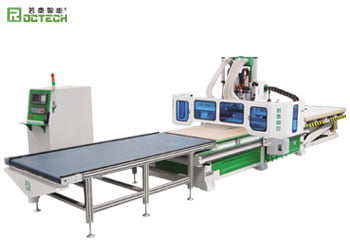
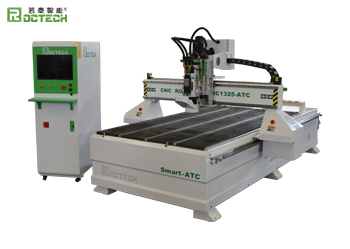
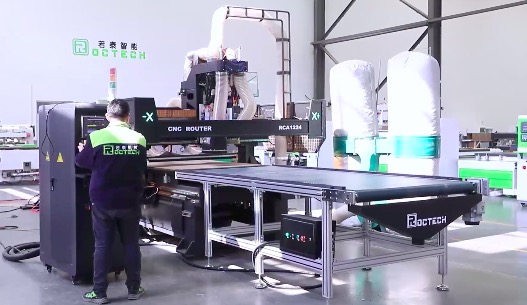
In a typical woodworking nesting center—such as Roctech’s RCA series automatic loading/unloading machines—a single production shift may use 8 to 12 different tools. These include compression spirals for panel cutting, ball-nose bits for edge profiling, and diamond-tipped tools for high-volume runs. Without a reliable tool grinder, tool replacement costs can exceed 15% of total operating expenses.
Roctech, a leading manufacturer of CNC routers and machining centers headquartered in Jinan, Shandong, emphasizes the importance of tool maintenance in its customer training programs. Their RCA1224 nesting center, equipped with a 9.6 kW spindle and Taiwan Syntec control system, processes panels at feed rates up to 30,000 mm/min. Such speeds demand tools that maintain edge geometry after repeated cuts. Roctech recommends that users invest in a mid-range tool grinder with at least 0.02 mm repeatability and a minimum 6,000 RPM grinding spindle for resharpening carbide and PCD tools.
For stone engraving, tool wear is even more aggressive. Diamond-tipped tools used on granite or marble lose effectiveness after 10–15 linear meters of cut. In this context, the grinder must handle diamond wheel dressing and maintain a consistent cutting edge angle. Vollmer’s QWD series is often cited as a reference, but for cost-sensitive operations, Chinese brands like Naxa have developed models that incorporate diamond wheel technology at a 60% lower price point.
The practical decision for a shop floor manager is not about the “best” brand in absolute terms but about matching grinder capabilities to the tool types and volumes used. For a custom furniture shop running two nesting centers, a Tormek manual system may suffice for simple edge tools, but for high-mix production with indexable inserts and complex profiles, a CNC-controlled grinder from Naxa or a refurbished Walter machine becomes necessary.
Conclusion and Outlook
The question of which tool grinder brand is “good” cannot be answered without reference to the specific machining context. For high-precision carbide tooling
Looking for more information about our CNC machines and services? Contact us today.
Contact
Previous:在木工CNC设备的世界里,RC1325RH-ATC这个名字对...
Next:Not






















Selecting the Right Tool Grinder for CNC Machining: A Technical Evaluation - Roctech® have advanced technology for CNC Router,cnc router cabinets,Roctech already have 15 years experiences of cnc router technology.-© 2023 Roctech® Machinery Co.,Ltd. - All Rights Reserved Website Terms Of Use ● Privacy Policy ● Cookie Policy