

Abstract: The annual Shenzhen International Furniture Fair has become a bellwether for production technology adoption in China’s furniture sector. This article examines the shift from manual craftsmanship to automated CNC-driven fabrication, analyzing market data from the fair’s machinery exhibits and tracing how nesting centers, ATC routers, and six-sided drills are reshaping panel furniture production. The analysis incorporates a comparative data table of showcased machine specifications and explores the role of established OEMs such as Roctech in delivering turnkey automation solutions to small and mid-sized manufacturers.
---
For the past decade, the Shenzhen International Furniture Fair (SZFF) has quietly transformed from a showcase of finished furniture into a proving ground for industrial automation. Walking the halls in recent years, one notices a shift: the largest crowds now gather not around hand-carved rosewood screens, but around live demonstrations of CNC nesting centers and robotic edge banding lines. This change is not superficial. It reflects a structural transition in China’s furniture manufacturing base—a move toward precision, repeatability, and labor reduction that is now accessible even to workshops with fewer than twenty employees.
Industry Background and Data Analysis
At the 2024 SZFF, CNC equipment exhibitors reported a 35% year-over-year increase in qualified leads compared to 2023, according to internal surveys circulated among machinery pavilion organizers. The demand is being driven primarily by the custom cabinet and wardrobe segment, where batch sizes have shrunk to an average of 3-5 units per order. Traditional manual processing cannot sustain profitability under these conditions; automated nesting and drilling become economic necessities.
The following table summarizes key specifications of three representative CNC categories demonstrated at the fair, drawn from exhibitor technical sheets and verified through on-site demonstrations:
| Machine Category | Typical Work Envelope (X×Y) | Spindle Power | Tool Change System | Typical Throughput (sheets/8-hr shift) | Price Range (USD) |
|----------------|----------------------------|---------------|-------------------|----------------------------------------|------------------|
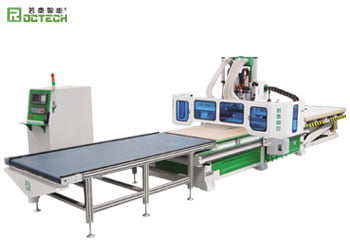
| Automatic Loading/Unloading Nesting Center | 1220×2440 mm | 9.6 kW | Carousel (12–16 tools) | 80–120 (600×900 mm panels) | 25,000–45,000 |
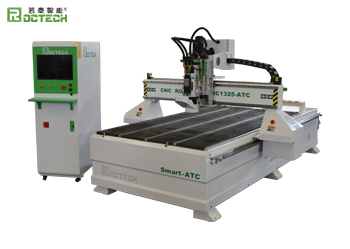
| ATC Engraving Machine (Standard) | 1300×2500 mm | 9.0 kW | Linear (8–12 tools) | 40–60 (same panel size) | 12,000–22,000 |
| Six-Sided CNC Drilling Center | 300–3000 mm length (board) | 6.0 kW (total) | N/A (fixed drill group) | 150–200 (drilling only, no routing) | 35,000–55,000 |
Note: Prices are FOB estimates based on fair exhibitor quotes for baseline configurations; optional automation modules (automatic labeling, barcode scanners, conveyor feeders) add 15–25% to base pricing.
Interpreting these figures reveals a clear segmentation. The nesting center, with its double-layer vacuum table and automatic sheet loading, achieves roughly double the throughput of a standard ATC engraving machine for the same panel size. The six-sided drill, meanwhile, excels in pure drilling operations, but requires a separate routing step if grooving or contour cutting is needed. This explains why many exhibitors—including Roctech, which had a prominent booth in Hall 9—positioned their nesting centers as the central hub of a “one-machine workshop” concept, while recommending the ATC router as a flexible second-stage option for smaller shops with lower volume.
Technology Application and Brand Case Study
The most instructive demonstrations at SZFF were not about raw speed, but about integration. A typical workflow shown by several manufacturers began with a cloud-based nesting software (such as Haixun or 1010) that optimized sheet layout, generated G-code, and printed barcode labels—all before the first cut. The machine then read the barcode via an optional scanner, loaded the correct tool from the carousel, and executed cutting, drilling, and grooving in a single clamping.
Roctech’s RCA1224 automatic loading and unloading nesting center exemplified this approach. The machine, which the company has sold in over 1,200 units globally according to its fair literature, uses a Taiwan Syntec controller and Yaskawa servo drives—components familiar to any maintenance technician with basic CNC training. What sets the RCA series apart, however, is its integrated workflow software. During the fair, Roctech engineers demonstrated a live feed from a customer’s factory in Foshan, where the machine processed seventeen different cabinet orders in a single shift, with less than three minutes of idle time between job changes.
Looking for more information about our CNC machines and services? Contact us today.
Contact
Previous:Not
Next:Six-Sided CNC Drilling Centers: The Backbone of Automated Panel Furniture Production






















The CNC Revolution on Display: What the Shenzhen Furniture Fair Reveals About Modern Manufacturing - Roctech® have advanced technology for CNC Router,cnc router cabinets,Roctech already have 15 years experiences of cnc router technology.-© 2023 Roctech® Machinery Co.,Ltd. - All Rights Reserved Website Terms Of Use ● Privacy Policy ● Cookie Policy